Hair Transplant Care in USA: Costs, Safety & Benefits
Written by: Kaan Sakar, Hair Transplant Advisor
Last Updated: September 2026
Choosing where to have a hair transplant is about more than comparing graft counts and prices. The quality of the surgical plan, who actually performs the procedure, how carefully your donor hair is managed, and what happens during the months after surgery can all affect the final result.
For patients considering a hair transplant in the United States, understanding how treatment is typically structured can make it easier to compare clinics, surgeons, and overseas alternatives.
This guide explains what to look for when considering hair transplant care in the USA, including costs, surgeon involvement, safety, recovery, and long-term follow-up.
What Does Hair Transplant Care in the USA Include?
A hair transplant should be viewed as a process rather than a single day of surgery.
The process typically includes:
-
Hair-loss and donor-area assessment
-
Hairline and surgical planning
-
Estimation of the number of grafts required
-
Selection of FUE, FUT or another appropriate approach
-
The surgical procedure
-
Immediate postoperative care
-
Washing and recovery instructions
-
Follow-up during the growth period
-
Management of continued natural hair loss
This last point is particularly important. A hair transplant moves existing follicles. It does not stop the rest of your non-transplanted hair from continuing to thin.
The American Academy of Dermatology notes that physicians may recommend medical treatment after transplantation because continued hair loss can affect the appearance of the result over time.
Who Actually Performs Your Hair Transplant?
One of the most important questions to ask any clinic is:
Who will perform each part of my procedure?
Hair transplantation involves several different steps, including:
-
Designing the hairline
-
Planning the donor area
-
Administering anesthesia
-
Extracting or surgically harvesting donor follicles
-
Creating recipient sites or incisions
-
Preparing grafts
-
Placing grafts
Hair-transplant teams frequently include trained technicians. That alone should not be considered unusual.
What matters is understanding exactly which parts will be performed by the physician and which will be delegated to the surgical team.
The American Academy of Dermatology describes hair transplantation as a procedure in which the physician removes healthy donor hairs and prepares the recipient scalp, while members of the transplant team may assist with graft preparation and placement.
Before booking, ask the clinic to explain the division of responsibility clearly rather than simply asking whether the procedure is "doctor supervised."
Physician Qualifications and the Legal Scope of Surgical Delegation
Surgical Step
Authorized Practitioner Scope
Unlicensed Technician Scope
Legal Compliance Standard
Diagnostic Evaluation & Treatment Planning
Licensed Physician ONLY
Strictly Prohibited
Requires medical board licensure
Hairline Design & Recipient Planning
Licensed Physician (or licensed PA/NP)
Strictly Prohibited
Constitutes medical surgical practice
Donor Harvesting (FUE Punches / Strip Excision)
Licensed Physician (or licensed PA/NP)
Strictly Prohibited
Dermal incisions are surgical acts
Recipient Site Incisions
Licensed Physician (or licensed PA/NP)
Strictly Prohibited
Incisional site creation requires medical license
Graft Dissection & Placement
Physician, Allied Health, Techs
Permitted under direct supervision
Non-incisional handling is legally delegable
Who is legally allowed to perform hair transplant surgery in the USA?
Hair-transplant scope-of-practice rules vary by state. Patients should verify the operating clinician's license and confirm who performs FUE harvesting, recipient-site creation, and graft placement. The ISHRS position statement also distinguishes physician surgical responsibilities from tasks that may be delegated to licensed professionals within local scope-of-practice rules.
Evaluating domestic providers requires verifying credentials through recognized regulatory and professional bodies. Physicians should maintain primary board certification in relevant medical specialties, such as Dermatology, Plastic Surgery, or Otolaryngology.
Dedicated expertise is signaled by Diplomate status with the American Board of Hair Restoration Surgery (ABHRS). Earning ABHRS certification requires passing comprehensive written and oral examinations, submitting peer-reviewed patient surgical cases, and adhering to continuing medical education mandates.
The International Society of Hair Restoration Surgery (ISHRS) warns consumers against clinics operating under "turnkey" or "token doctor" models. In these illicit setups, a non-specialist physician purchases an automated hair restoration device and delegates the surgical procedure—including scalp incisions and graft extractions—to unlicensed traveling technicians.
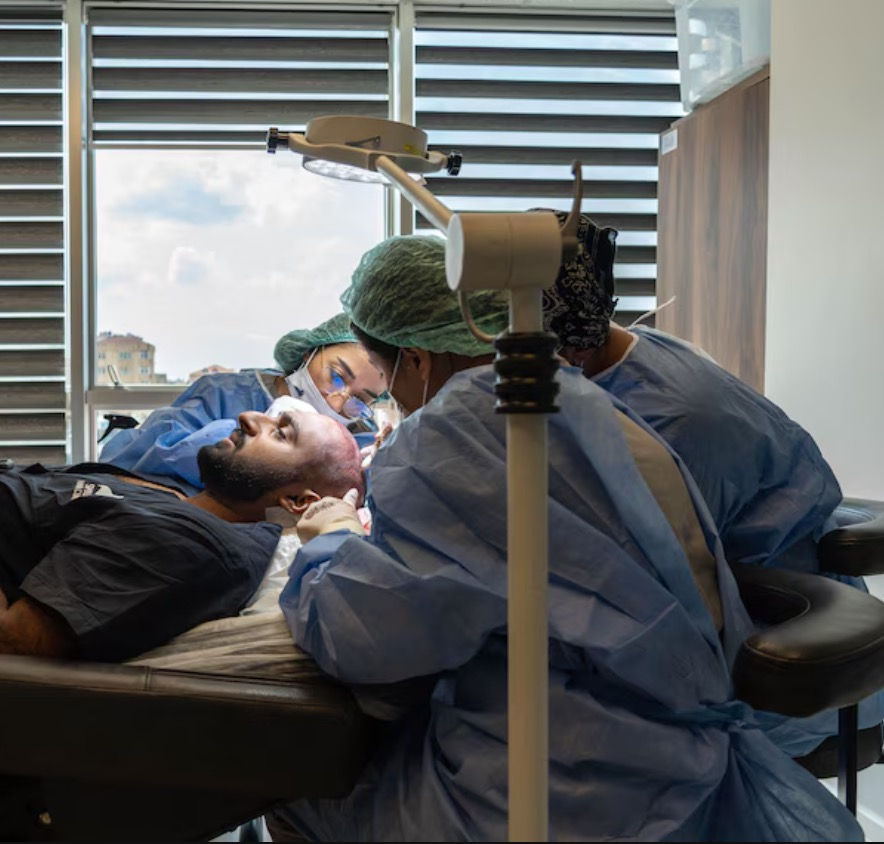
Medical board rulings in states such as California, Florida, and Virginia specify that making incisional cuts in the skin constitutes the practice of medicine. Unlicensed technicians are legally restricted to non-invasive support roles, such as microscopic graft dissection and assisting with blunt graft insertion into physician-created recipient sites.
FUE vs. FUT: Comprehensive Method Comparison
What is the difference between FUE and FUT hair transplants?
FUE extracts individual follicular units using micro-punches, leaving tiny dot scars that allow short hairstyles. FUT excises a strip of donor scalp, leaving a fine linear scar, but offers higher graft yields for advanced hair loss at a lower per-graft cost.
Clinical Parameter
FUE
FUT
Technique
Individual follicular units extracted one by one manually or blindly.
A strip of the scalp is removed from the donor area.
Scarring
Tiny white dot scars, barely visible even with short hair.
A linear scar along the back of the head, visible with short hair.
Ideal Candidates
Those who prefer wearing hair short or have limited scalp laxity.
Those who need a large number of grafts for extensive hair loss.
Recovery Time
Short recovery; most return to activities within a few days.
Longer recovery; stitches are typically removed in 10-14 days.
Graft Yield
High graft yield, though some grafts may be compromised.
Excellent graft yield, as the strip allows for precise dissection.
Price Point
Generally more expensive per graft due to intensive labor.
Often more cost-effective for large transplantation sessions.
Follicular Unit Extraction (FUE) involves harvesting individual follicular units (containing 1 to 4 hairs) directly from the donor area using motorized or manual micro-punches. FUE avoids a linear donor scar, decreases post-operative pain, and enables rapid healing, making it ideal for patients who prefer short haircuts. However, FUE requires shaving the donor area, takes longer to perform, and carries a higher cost per graft. Session sizes are typically capped to prevent donor over-harvesting and visible hair thinning.
Follicular Unit Transplantation (FUT / Strip Method) involves excising a strip of hair-bearing scalp from the permanent donor zone, which is then dissected into individual grafts under stereomicroscopes. FUT maximizes graft yield in a single session, achieves low graft transection rates, and preserves adjacent donor hair for future procedures at a lower per-graft cost. Its primary limitation is a continuous linear scar across the donor region, requiring hair to be worn at longer lengths to keep the site concealed.
Structural Advantages of Domestic Patient Continuity and Legal Protections
Why choose domestic hair transplant care over medical tourism?
Domestic care guarantees access to accredited facilities, clear communication in English, direct doctor accountability, and ongoing follow-up visits. If complications occur, U.S. patients benefit from clear medical continuity and enforceable legal recourse.
A primary benefit of domestic hair restoration is long-term continuity of care. Graft survival depends on proper care during the initial healing phases, and domestic patients benefit from in-person evaluations at critical milestones (1 week, 1 month, 6 months, and 12 months) to monitor density and manage healing concerns promptly.
Domestic care also establishes clear legal accountability. In the event of surgical negligence or severe complications, U.S. patients operate within established malpractice and regulatory frameworks overseen by state medical boards. Overseas clinic contracts rarely offer enforceable legal protections. Furthermore, complex surgical consent, aftercare instructions, and medical history reviews occur without language barriers, eliminating miscommunications regarding long-term expectations or drug interactions.
The Comprehensive Reality: USA vs. Overseas Medical Tourism
Is traveling to Turkey for a cheap hair transplant worth the risk?
Overseas medical tourism offers low package prices ($2,000–$4,000), but creates significant clinical risks. Patients face potential donor over-harvesting, technician-led surgeries, limited legal recourse, and high costs if local revision surgery is needed.
Economic analyses of the global health sector, such as research published by Brandeis University's Crown Center, document how state subsidies and aggressive commercial scaling transformed cities like Istanbul into major international hubs for hair restoration. Low-cost international centers frequently operate high-throughput "assembly-line" clinic structures to keep prices low.
Independent investigations into commercial clinics—including a comprehensive report by ABC News on Turkey's hair transplant tourism boom—highlight how high daily patient volumes frequently lead to non-physicians executing surgical incisions, raising severe safety concerns. In these environments, a single physician may oversee dozens of simultaneous surgeries, delegating graft extractions and recipient site incisions entirely to unlicensed staff. This introduces several key clinical risks:
-
Donor Zone Exhaustion: Over-harvesting FUE grafts can permanently deplete the donor area, leaving visible scarring and limiting options for future corrective procedures.
-
Compromised Graft Survival: Extended out-of-body times, poor temperature control, and improper handling by untrained staff significantly reduce graft survival rates.
-
Follow-up Challenges: When post-operative complications—such as donor necrosis, deep scalp infections, or cobblestoning—occur after returning home, local U.S. surgeons are often reluctant to take over another clinic's unresolved surgical case.
Intraoperative Workflow and Clinical Procedures
What happens during a hair transplant procedure day?
A hair transplant takes 6 to 8 hours. The clinical team prepares the donor scalp, administers local anesthesia, harvests follicular grafts, creates recipient sites at natural hair angles, and carefully places the grafts into thin areas.
The surgical day begins with vital sign checks, donor region shaving, and final hairline marking. The surgeon designs the hairline based on facial geometry, age, and future loss projections. Local anesthetics (lidocaine with epinephrine) are injected into the donor and recipient sites; while initial injections cause temporary stinging, the scalp remains completely numb throughout the procedure.
During the extraction phase, individual grafts are harvested using micro-punches (FUE) or a strip of donor tissue is excised and closed with sutures (FUT). Harvested grafts are organized, counted, and stored in chilled holding solutions to maximize tissue survival. The operating surgeon then creates recipient slits using micro-blades, establishing the exact depth, direction, angle, and density of the new hair. Finally, surgical technicians place individual grafts into the recipient sites under direct physician supervision before the scalp is cleaned, dressed, and the patient is discharged.
Post-Operative Recovery Timeline and Growth Dynamics
What is the recovery timeline for a hair transplant?
Patients resume desk work within 3 to 7 days. Scabs shed by day 10, followed by temporary hair shedding (shock loss) between weeks 2 and 6. New hair growth begins at month 3, with final density achieved between months 12 and 18.
During the first 10 days, micro-scabs form around each graft slit. Patients sleep with their head elevated and avoid direct physical contact with the recipient area until gentle washing routines remove the scabs by day 10. Between weeks 2 and 6, transplanted hair shafts fall out while the follicle roots remain dormant beneath the skin. This temporary shedding ("shock loss") is a standard physiological response to surgical trauma.
New hair growth begins around months 3 to 4 as fine, thin shafts emerge from the scalp surface. Coverage increases significantly between months 6 and 9, with approximately 50% to 70% of ultimate density visible by month 6. Transplanted hair shafts mature, thicken, and adapt to natural wave patterns between months 12 and 18, yielding final surgical density.
Clinical Candidacy, Risk Factors, and Contraindications
Who is a good candidate for a hair transplant?
Ideal candidates have stable patterns of male or female hair loss, adequate donor hair density, and good general health. Surgery is contraindicated for active scalp disorders, unmanaged chronic illness, or severe hair loss with insufficient donor supply.
Suitable candidates must maintain adequate donor hair density in the permanent occipital zone to cover present and projected balding areas. Performing extensive procedures on young patients (e.g., under age 25) with active balding carries a high risk of leaving isolated hair islands as natural hair loss progresses. Patients must also understand that transplantation redistributes existing hair rather than creating new hair follicles.
Standard surgical risks include localized infection, temporary donor zone numbness, folliculitis, poor graft survival, and visible scarring. Absolute contraindications include active autoimmune scalp conditions (such as Lichen Planopilaris or Frontal Fibrosing Alopecia), diffuse unpatterned alopecia (DUPA), severe keloid scar formation, or unmanaged systemic medical conditions.
Frequently Asked Questions
How much does a hair transplant cost in the USA?
Most U.S. hair transplant procedures cost between $6,000 and $12,000 for a standard 2,000-graft session. Overall costs range from $4,000 for minor hairline restoration to $20,000+ for extensive multi-session procedures in high-overhead metropolitan areas.
Is a hair transplant painful?
The procedure is performed under local anesthesia, which numbs the scalp completely during surgery. Patients feel brief stinging during the initial anesthetic injections, followed by mild tightness or discomfort during early recovery that responds well to over-the-counter or mild prescription pain medications.
Are hair transplant results permanent?
Transplanted follicles harvested from the permanent donor region retain their genetic resistance to dihydrotestosterone (DHT), allowing them to grow for life. However, native non-transplanted hair remains susceptible to progressive thinning, often requiring preventive maintenance medications.
Who is a good candidate for a domestic hair transplant?
Ideal candidates have stable pattern hair loss, sufficient donor hair density on the back and sides of the head, realistic expectations, and overall good health. Patients with unstable, active hair loss or autoimmune scalp conditions are generally advised to pursue medical therapy first.
How long does recovery take after a hair transplant?
Initial healing takes 7 to 10 days, by which point scabs drop off and normal daily activities resume. Transplanted hairs shed within 2 to 6 weeks, new growth begins around month 3, and final results mature between months 12 and 18.
Do U.S. hair transplant clinics offer guarantees?
Reputable clinics provide formal growth evaluations and revision policies, but ethical surgeons cannot guarantee 100% graft survival. Informed consent guidelines mandate clear documentation of surgical risks and individual growth variability.
Hair Transplant in the USA:Why Choose Domestic Care?
This article is Written by HairInUSA Editorial Team | Medically Reviewed by Dr. Japhlet Aranas, ABHRS Board-Certified Hair Restoration Surgeon